Chronic Insomnia: What’s Really Keeping You Up at Night?
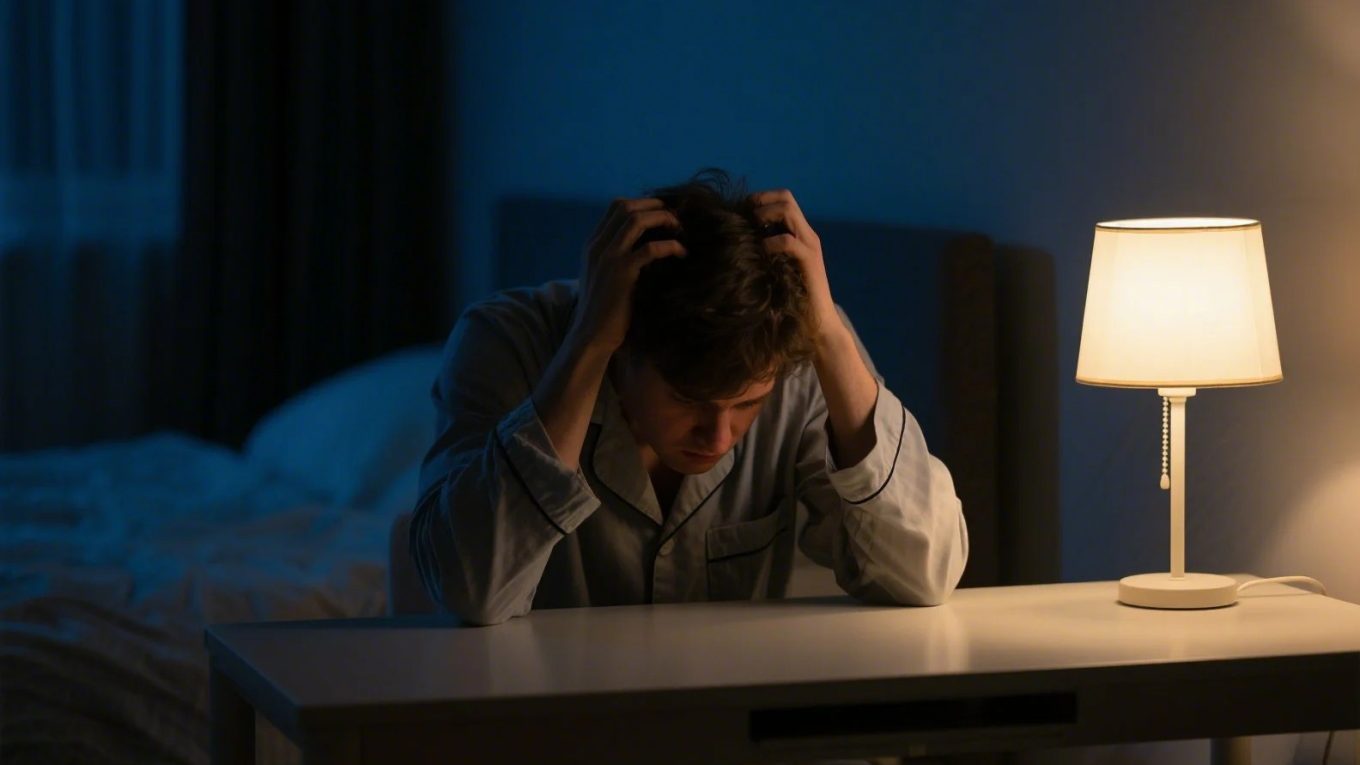
2:47 AM.
You’ve been lying in bed for three hours. Your mind is racing — replaying conversations from 2018, worrying about work tomorrow, calculating how few hours of sleep you’ll get if you fall asleep RIGHT NOW.
You check your phone. 3:12 AM. Then 3:45 AM. Then you give up and start scrolling. At 5 AM, you finally drift off — only to wake up groggy, irritable, and reaching for your third cup of coffee by noon.
Sound familiar?
Chronic insomnia affects 30–35% of American adults, according to the American Academy of Sleep Medicine. It’s not just “a few bad nights” — it’s persistent difficulty falling asleep, staying asleep, or waking up too early, at least three nights per week for three months or longer.
And for most people, the real question isn’t “why can’t I sleep?” — it’s “what is my body trying to tell me?”
🧠 Insomnia Isn’t Just “Being Bad at Sleep”
Here’s the first thing to understand: insomnia is almost never the primary problem. It’s a symptom. Your body is trying to tell you something, and the sleeplessness is the alarm.
The medical community classifies insomnia into two main categories:
- Primary insomnia — sleep problems not directly caused by another health condition (this is less common than most people think)
- Secondary insomnia — sleep problems caused by something else: mental health conditions, medical issues, medications, or substance use (this is the vast majority of cases)
Let’s walk through what might actually be keeping you up.
😰 Cause #1: Stress and Anxiety

This is the #1 cause of insomnia in America — and it’s not close.
When you’re stressed, your brain activates the sympathetic nervous system (fight-or-flight). This releases cortisol and adrenaline — hormones that increase alertness, heart rate, and blood pressure. This is great if you’re being chased by a bear. It’s terrible if you’re trying to fall asleep.
The cruel feedback loop:
- You can’t sleep because you’re stressed
- You stress about not sleeping
- The stress makes it harder to sleep
- You lose more sleep, which increases your stress
A 2021 study in Current Psychiatry Reports found that hyperarousal — a state of elevated physiological and psychological alertness — is the central mechanism in chronic insomnia. In other words, your nervous system is stuck in “on” mode.
Generalized Anxiety Disorder (GAD) is strongly linked to insomnia — about 70% of people with GAD have significant sleep problems. But even sub-clinical anxiety (worrying that doesn’t meet the diagnostic threshold) can wreck your sleep.
📱 Cause #2: Blue Light and Screen Time

You’ve heard this one before. But you’re probably still doing it — so let’s talk about why it matters.
Your body runs on a circadian rhythm — an internal clock that regulates sleep-wake cycles. This rhythm is controlled largely by light exposure to your eyes. Specifically:
- ☀️ Bright light (especially blue wavelengths) → signals “it’s daytime” → suppresses melatonin → promotes alertness
- 🌙 Darkness → signals “it’s night” → releases melatonin → promotes sleepiness
Here’s the problem: your phone emits blue light. So does your laptop. So does your tablet. And when you stare at them at 11 PM, you’re essentially telling your brain: “Hey, it’s noon. Stay alert.”
A Harvard Medical School study found that blue light exposure in the evening suppressed melatonin for twice as long as green light exposure, and shifted circadian rhythms by twice as much.
It’s not just the light. Content matters too. Doomscrolling news, checking work email, or watching intense dramas all activate your brain in ways that are incompatible with sleep.
☕ Cause #3: Caffeine, Alcohol, and What You Consume

Caffeine has a half-life of 5–6 hours. That means if you drink a cup of coffee at 4 PM, by 10 PM half of that caffeine is still in your system — still blocking adenosine (the chemical that makes you feel sleepy), still keeping you alert.
A study in the Journal of Clinical Sleep Medicine found that caffeine consumed even 6 hours before bedtime significantly reduced total sleep time by more than an hour. Many people think “I can drink coffee and still fall asleep” — and they might be right. But their sleep quality is compromised.
Alcohol is sneakier. It helps you fall asleep faster — but it destroys sleep quality. Alcohol consumption:
- Suppresses REM sleep (the restorative phase where memory consolidation happens)
- Causes fragmented sleep as your body metabolizes it
- Increases middle-of-the-night awakenings
- Worsens sleep apnea and snoring
Nicotine is a stimulant too. Smokers often have more difficulty falling asleep and experience more sleep fragmentation throughout the night.
🏥 Cause #4: Underlying Medical Conditions

Many cases of chronic insomnia trace back to health issues that have nothing to do with “sleep habits”:
- Sleep Apnea — 25% of men and 10% of women have obstructive sleep apnea, where breathing repeatedly stops during sleep. Your brain wakes you slightly to breathe — hundreds of times per night. You may not remember these awakenings, but they fragment your sleep dramatically
- Thyroid Disorders — both overactive (hyperthyroidism) and underactive (hypothyroidism) can cause sleep problems. Hyperthyroidism causes difficulty falling asleep; hypothyroidism causes excessive daytime sleepiness and fragmented sleep
- Chronic Pain — arthritis, fibromyalgia, back pain, headaches — pain makes sleep difficult, and poor sleep lowers pain tolerance. Another vicious cycle
- Mental Health Conditions — depression often causes early-morning awakening; bipolar disorder is closely linked to circadian rhythm disruption; PTSD causes nightmares and hyperarousal
- Restless Leg Syndrome — an irresistible urge to move your legs makes falling asleep nearly impossible
- Gastrointestinal Issues — acid reflux worsens when lying down, causing frequent awakenings
A 2019 study in the Journal of Clinical Medicine found that patients with chronic insomnia were significantly more likely to have undiagnosed thyroid disorders, anemia, and vitamin D deficiency.
💊 Cause #5: Medications
Common medications that can interfere with sleep:
- Antidepressants (especially SSRIs like fluoxetine and bupropion)
- Beta-blockers (for blood pressure) — they suppress melatonin production
- Corticosteroids (prednisone for inflammation)
- Stimulants (ADHD medications, some decongestants)
- Diuretics — cause nighttime urination
- Thyroid medication (if taken at night)
If your insomnia started after beginning a new medication, that’s not a coincidence. Talk to your prescribing doctor about timing adjustments or alternatives.
✅ The Action Plan: What To Do About It
Chronic insomnia is treatable. But it requires addressing the cause — not just the symptom. Here’s what actually works:
1. Cognitive Behavioral Therapy for Insomnia (CBT-I)
This is the gold standard treatment, recommended by the American College of Physicians as first-line therapy. A 2016 meta-analysis found CBT-I improved sleep in 70–80% of patients — better than sleeping pills. It addresses the thoughts and behaviors that maintain insomnia.
2. Sleep Hygiene (But Actually Do It)
- 📵 No screens 60–90 minutes before bed (or use blue-light-blocking glasses)
- 🕐 Consistent sleep and wake times — even on weekends
- ☕ No caffeine after 12 PM
- 🍷 No alcohol within 3 hours of bedtime
- 🔦 Bright light exposure during the day; darkness at night
- 🛏️ Bed = sleep only. No reading, no TV, no doomscrolling
3. Get Checked
If lifestyle changes don’t help after 2–4 weeks, see your doctor for:
- Blood work: thyroid panel, vitamin D, iron/ferritin, cortisol
- Sleep study: rule out apnea and other disorders
- Mental health screening: anxiety and depression
4. Be Careful With Sleeping Pills
Sedatives (Ambien, Lunesta, benzodiazepines) are meant for short-term use only. Long-term, they:
- Stop working (tolerance develops)
- Can cause dependence
- Actually worsen sleep quality — they knock you out but don’t give you restorative sleep
They’re a band-aid, not a cure.
5. Address the Underlying Cause
If it’s anxiety, treat the anxiety. If it’s apnea, get a CPAP. If it’s your thyroid, manage your thyroid. Insomnia is a symptom — find the root cause.
💡 A Final Thought
If you’ve been waking up tired for months (or years), your body is trying to get your attention.
Yes, sometimes the cause is simple — too much coffee, too much Netflix, too much scrolling. But often, chronic insomnia is your nervous system telling you that something deeper needs addressing: chronic stress that you’ve normalized, anxiety you’ve been pushing down, or a health condition you didn’t know you had.
The people who solve their insomnia aren’t the ones who just “try harder” to sleep. They’re the ones who get curious about what’s keeping them up — and then do something about it.
You deserve rest. Not just sleep — actual, restorative rest. And it starts with paying attention to what your body has been trying to tell you.
Sleep isn’t a luxury. It’s a biological necessity.
And your body is asking for help.
What keeps YOU up at night? Have you found something that works? Share your experience below — your insight might help someone else who’s still searching for answers. 💬