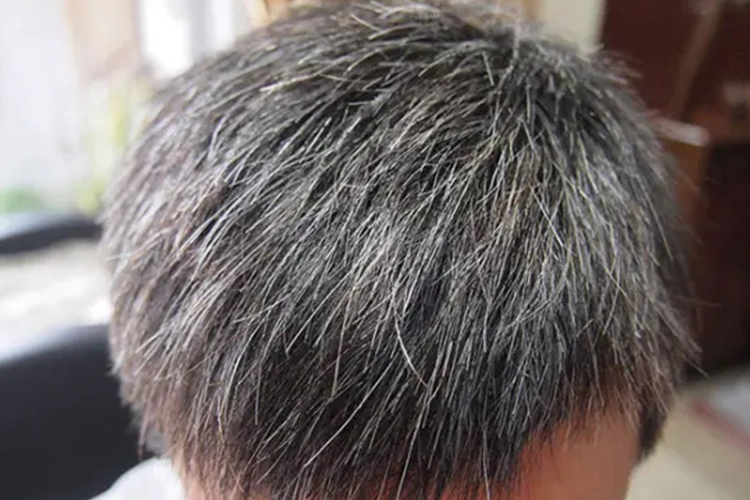
You’re Young and Already Getting Gray Hair — Now What?
You catch it in the mirror one morning. A silver strand near your temple. You tell yourself it’s nothing. Then another. Then a patch.
You’re 24. Or 19. Or maybe even younger.
And now you’re standing in the bathroom at 7am, plucking gray hairs with a sinking feeling in your chest: Is this normal? Is something wrong with me?
Here’s what you need to hear: premature graying is more common than you think, and in most cases, it’s not a medical emergency. But it’s also not completely meaningless — your body might be sending you a signal worth listening to.
Let’s break down what causes gray hair in young people, what you can actually do about it, and how to stop spiraling every time you find a new one.
🧬 Why Hair Turns Gray: The Science
Hair gets its color from melanin — a pigment produced by cells called melanocytes, which live at the base of your hair follicles. These melanocytes inject pigment (eumelanin for brown/black or pheomelanin for red/blonde) into the keratin cells that make up your hair shaft.
Over time, melanocytes naturally decline in activity and number. When they stop producing melanin, new hair grows in colorless — gray, white, or silver.
The enzyme responsible for melanin production is tyrosinase. And here’s the key: tyrosinase is extremely sensitive to oxidative stress. When reactive oxygen species (free radicals) accumulate in the hair follicle, they damage tyrosinase and melanin production grinds to a halt.
Premature graying (before age 25 for Caucasians, before age 30 for African Americans, before age 35 for Asians) is when the process accelerates beyond its normal timeline.
😰 Cause #1: Stress — Yes, It’s Real
The connection between stress and gray hair became scientific fact in 2020, when Harvard researchers published a landmark study in Nature.
What they found: acute stress activates the sympathetic nervous system (fight-or-flight), which releases norepinephrine (noradrenaline) directly into the hair follicle. This causes melanocyte stem cells — the reservoir of cells that would normally become melanocytes — to rapidly deplete and disappear.
In plain English: stress literally uses up your melanocyte stem cells. And unlike other cell types, these don’t regenerate. Once they’re gone, they’re gone.
This is why many people report a dramatic onset of gray hair following major stressors — a divorce, a death in the family, a period of intense overwork. The stress didn’t cause the gray to appear overnight (hair grows from the root; gray hair you see today started growing weeks ago). But the acceleration was real.
“The stem cells that color your hair are finite. Stress can deplete them faster than normal aging.”
— Dr. Ya-Chieh Hsu, Harvard Stem Cell Institute
🧬 Cause #2: Genetics — The Biggest Factor
Before you blame your lifestyle, know this: genetics account for the majority of variation in hair graying timing.
A 2016 study in Nature Communications analyzed the genomes of over 6,000 people and identified IRF4 — a gene involved in melanin production regulation — as a key genetic determinant of gray hair timing. People with certain variants of this gene gray earlier.
So if your parents or grandparents started going gray young, you probably will too. It’s not your diet, your stress level, or your shampoo. It’s your DNA.
That said, genetics loads the gun — but environment often pulls the trigger. The same genetic predisposition might result in gray hair at 25 under chronic stress, or at 45 under a relatively calm life.
🥗 Cause #3: Nutritional Deficiencies
Here’s where the connection to “kidney deficiency” and TCM becomes interesting from a Western perspective. The nutrients most critical for melanin production:
Vitamin B12
One of the strongest associations with premature graying is B12 deficiency. A 2013 study in the International Journal of Trichology found that 76% of patients with premature graying had B12 deficiency. B12 is essential for cell division, DNA synthesis, and — crucially — melanin production.
Best sources: Meat, fish, eggs, dairy. Vegans are at higher risk.
Copper
Copper is a cofactor for tyrosinase — the enzyme that kickstarts melanin synthesis. Low copper → reduced melanin → earlier graying. A 2012 study in Biological Trace Element Research found significantly lower serum copper in premature gray hair patients vs. controls.
Best sources: Organ meats, oysters, shiitake mushrooms, nuts, seeds
Iron and Ferritin
Iron deficiency anemia is associated with early graying in multiple studies. Iron is critical for the cellular energy production that melanocytes need to function.
Folic Acid (B9)
Works with B12 in melanin synthesis. Deficiency is common in young people eating poor diets.
🏥 Cause #4: Thyroid and Hormonal Disorders
The thyroid gland regulates metabolism across your entire body — including hair follicle function. Both hypothyroidism and hyperthyroidism are associated with premature graying:
- 🩸 Hypothyroidism: slowed metabolism → reduced melanocyte activity
- 🔥 Hyperthyroidism: increased oxidative stress → accelerated melanocyte damage
A 2018 study in Indian Dermatology Online Journal found that thyroid autoantibodies (markers of autoimmune thyroid disease) were significantly more common in people with premature graying.
This is why I recommend asking your doctor to check your thyroid if you’re seeing significant graying before age 30 — especially if you have other symptoms (fatigue, weight changes, temperature sensitivity, irregular periods).
🧪 Cause #5: Autoimmune Conditions
Certain autoimmune diseases specifically target melanocytes:
- Vitiligo — the immune system attacks and destroys melanocytes in patches. Gray hair in affected patches is often the first sign
- Alopecia areata — can cause sudden graying when new regrowth comes in white/gray
- Hashimoto’s thyroiditis — autoimmune thyroid damage is associated with early graying
If your graying is patchy (not diffuse), or if you’re also noticing white patches on your skin, see a dermatologist — you may need to rule out vitiligo.
✅ What You Can Actually Do About It
1. Get Your Labs Done
If you’re under 30 and graying rapidly, ask your doctor for:
- Full thyroid panel (TSH, free T3, free T4, TPO antibodies)
- Vitamin B12 level
- Ferritin and iron panel
- Copper level (if available)
2. Optimize Your Nutrition
- 🥩 Animal protein (B12 and bioavailable iron) — especially if vegan/vegetarian, supplement B12
- 🦪 Oysters (copper and zinc) — 3oz provides 500% of daily copper needs
- 🥬 Dark leafy greens — folate and iron
- 🥜 Nuts and seeds — copper and zinc
- 🍳 Eggs — B12 and biotin
3. Reduce Oxidative Stress
Since oxidative stress is the mechanism of graying, reducing it may slow progression:
- 🧘 Stress management — meditation, sleep, exercise
- ☀️ Antioxidant-rich foods — colorful vegetables, berries, green tea
- 🚭 Quit smoking — smoking dramatically accelerates graying; a 2013 study found smokers gray 2–3x faster
- ☕ Moderate caffeine — high doses may increase oxidative stress in hair follicles
4. Topical Treatments Worth Considering
- Melatonin — a 2023 study in Skin Pharmacology and Physiology found that topical melatonin reduced gray hair density in early-stage graying
- Gray hair shampoos — products with small amounts of semi-permanent color can reduce the appearance of gray
- Copper peptide products — topical copper supports tyrosinase function
5. When Nothing Else Works
Here’s the honest truth: you can’t reverse gray hair that’s already grown in — it’s colorless keratin. What you can do:
- 🖤 Dye it — the most common solution. Natural options like henna are gentler
- ✂️ Cut it out — if it’s concentrated in specific areas
- 💆 Embrace it — premature gray is increasingly normalized and even fashionable
💡 The TCM Perspective — With a Western Lens
Here’s the interesting part: in TCM, premature graying is strongly associated with kidney and liver deficiency. The kidneys store “Jing” (essence), which governs growth, reproduction, and aging. The liver “stores blood” and “governs the tendons” — which includes hair.
In Western terms, this maps to:
- 🧬 Kidney = adrenal glands + HPA axis — cortisol dysregulation accelerates graying (matches the stress finding)
- 🩸 Liver = detoxification and blood quality — poor liver function → toxin buildup → oxidative stress → graying
- 🩸 Blood = iron, B12, folate — all critical for melanin production
So when a TCM practitioner says your gray hair is from “kidney deficiency,” they’re describing the same phenomenon — just in a different language. The prescription they give (rest, nutrition, stress reduction, herbal support) often works because it addresses the real underlying factors.
💪 Stop Panicking. Here’s Your Action Plan.
- ✅ Rule out medical causes — thyroid panel + B12 + iron panel
- ✅ Check your family history — if parents/grandparents grayed young, it’s probably genetic
- ✅ Optimize nutrition — especially B12, copper, iron, folate
- ✅ Manage stress — this matters more than most people realize
- ✅ Quit smoking — one of the most modifiable risk factors
- ✅ Consider a dye or haircut — sometimes the fastest fix is the simplest one
Gray hair in your 20s feels like a betrayal by your own body. But here’s the reframe: your body is showing you something — about stress, nutrition, hormones, or genetics. Instead of fighting it with anxiety, use it as motivation to take better care of the system that’s trying to communicate with you.
And if it turns out to be genetic? There are worse things than looking a little distinguished before your time.
Gray hair isn’t a death sentence.
It’s a mirror — showing you where to look.
When did you start going gray? What have you tried? Share your story below — and whether you decided to fight it or embrace it. 💬